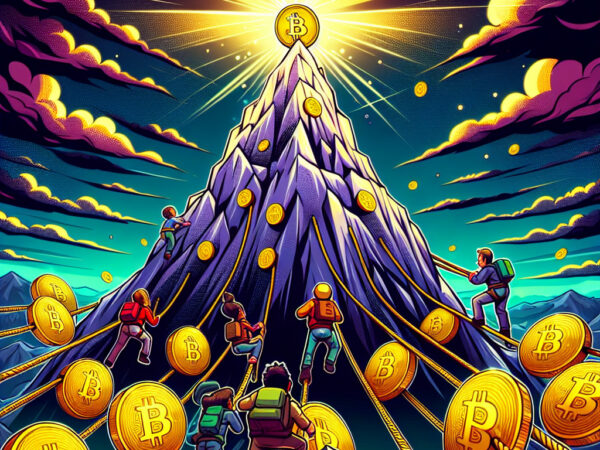
In the ever-evolving global financial market, agreements between major economic powers can have ripple effects that extend beyond traditional boundaries. When such a deal is in motion, it often sends signals that resonate across various sectors, including the dynamic world of cryptocurrencies.
Recently, discussions of a potential trade agreement between the United States and China have rekindled hopes among investors and analysts alike. This development, they suggest, could ignite a new wave of interest in digital currencies. Bitcoin, in particular, is being closely watched as a potential beneficiary in the event of a favorable accord between the two nations.
Understanding why Bitcoin might react positively to such geopolitical maneuvers requires a dive into the interconnectedness of global economies and new forms of digital assets. Firstly, it is crucial to recognize that Bitcoin is often perceived as a hedge against traditional market instability. Unlike conventional fiat currencies that are subject to inflation and the monetary policies of governments, Bitcoin operates on a decentralized network, making it appealing to those wary of geopolitical tensions and economic uncertainties.
Whenever the world’s two largest economies—those of the U.S. and China—make strides toward resolving their differences, it tends to inject a sense of optimism into global markets. This optimism can lead to increased investment activity, with investors seeking out both traditional and alternative assets. Bitcoin, with its decentralized nature and finite supply, often emerges as a compelling option during such times.
Trade deals have historically impacted currency values, stock prices, and even commodity markets. Yet, the implications for the cryptocurrency market are particularly intriguing. Bitcoin doesn’t just react to market optimism; it can also benefit from the complexities and potential uncertainties that such deals may bring, given that the digital currency is often seen as a store of value in times of economic flux.
Looking back, geopolitical events have consistently influenced digital currency markets. For instance, during periods of heightened trade tensions or financial instability, Bitcoin has occasionally seen a surge in demand as investors sought alternatives to traditional investment vehicles. The current discourse surrounding the U.S.-China trade negotiations is another potential catalyst that could drive similar movements.
Experts, however, caution against jumping to conclusions. While there is potential for Bitcoin to experience an uptick, the cryptocurrency market is notoriously unpredictable, often characterized by volatility and swift price swings. Investors eyeing Bitcoin as a reaction to the possible U.S.-China trade deal will need to weigh the risks and remain vigilantly informed.
As these negotiations unfold, they serve as a reminder of the increasingly interconnected nature of global financial systems and the growing relevance of digital currencies. Bitcoin, in this complex interplay of economics and technology, stands as a testament to the evolving landscape of modern investment.
The conversation between the U.S. and China, with its intricate dance of diplomacy and economics, highlights how developments in one sphere can spark movements in another entirely. In this intricate web of cause and effect, Bitcoin’s potential surge underscores a fascinating aspect of our contemporary financial reality, where traditional and emerging markets are in constant dialogue.
In the end, while experts may predict potential outcomes, the story of Bitcoin remains dynamic and ever-unfolding, much like the world it inhabits. It’s a narrative that invites both curiosity and caution, urging a closer examination of how we navigate the future of finance.